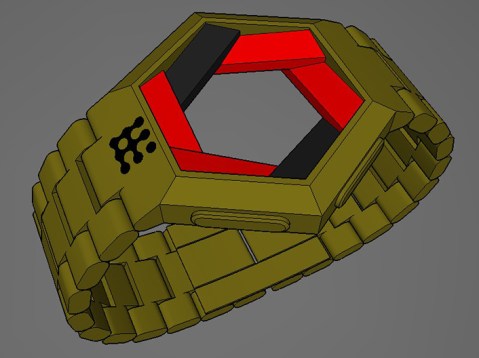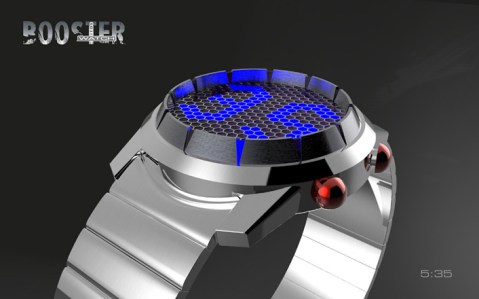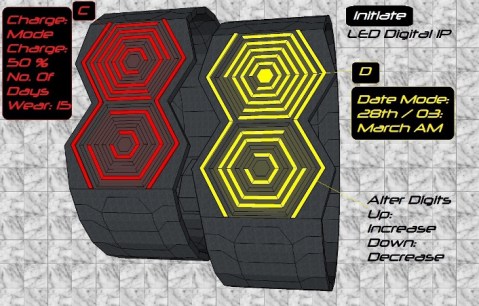
(English) ‘Rokkaku’ is a hexagon themed analogue watch
May 21st, 2013
(English) Design submitted by Heather from the USA.
Heather says: My brother thought up the phrase “SPLIT SECOND”, and this concept was born. I thought, maybe I can make a display that is mostly seconds, but split them in half so there is constant movement on a large portion of the display. Then I made the hours and minutes smaller and squeezed them in between the top and bottom of the seconds.
(English) Design submitted by Peter from the UK.
Peter says: Since my participation in the blog I have had a few ideas for watch design inspired by cube like forms. 3D Unlimited is one of my favourite TF designs and I love the simple but cryptic looking geometry. I have often thought it would be great if it was possible to create an analogue version. “Anacube” was the result. This design also takes a few cues form the internationally recognised puzzle “Rubik” cube.
(English) Design submitted by Andrew from the UK.
Andrew says: Ariadne is an evolution of the Web Design submitted by Laszlo from Hungary in August 2012. Which is Inspired by how a spider spins its Web.
(English) Design submitted by Peter from the UK.
Peter says: This design was inspired by a computer game logo from a game I played recently. As soon as I saw the logo I thought it would make a great watch face. “Hexecule” was the result.
(English) Design submitted by Peter from the UK.
Peter says: This is “Hypercube LCD” an LCD version of the original Hypercube design that featured on the blog back in July 2012.
I wanted to keep the same kind of faceted geometric cube shape that looks somewhere between architecture and jewelry, but this time using an LCD display.
(English) Design submitted by Kyle from the UK.
Kyle says: I was inspired when looking at symbols from different languages, when I started to sketch some interlocking lines similar to letters of different cultures I came to the formation of these three ‘Linked’ lines.
(English)
Kisai Spider is the latest concept watch design to become reality from the Tokyoflash Design Studio Blog. The original concept was featured on the blog in February 2012 and is now available to buy. Read the rest of this entry »
(English) Design submitted by Sam from Germany.
Sam says: XtalV is a variation of my Xtal concept that also used hexagon based numbers. This time I arranged them vertically and so the display looks even more cryptic, like an alien inscription.
(English) Design submitted by Laszlo from Hungary.
Laszlo says: Easy to read, always on, touchscreen LCD watch concept.
(English) Design submitted by Sam from Germany.
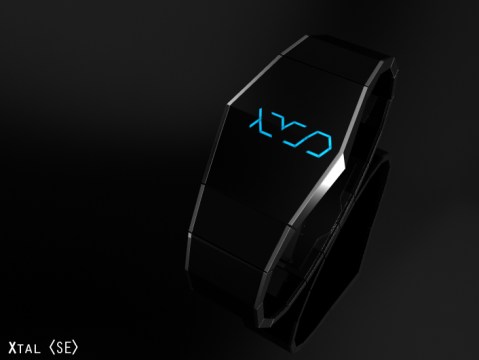
Sam Says: Xtal is the result of some small sketches I made when having lunch. When I looked back at the paper, I liked the initial mystery of the numbers, the simple geometry of the watch and the general edginess of everything.
(English) Design submitted by Sam from Germany.
Sam says: I really like hexagons and sketched alot for an analog watch inspired digital display that works with this interesting shape. Read the rest of this entry »
(English) Design by Laszlo from Hungary.
Laszlo says: Many of the digital concepts presented on the blog show hours and minutes, but not seconds. Including the seconds adds to the appeal because not only is it a more accurate representation of the time, but it also attracts more attention with an ever changing display. Read the rest of this entry »
(English) Design submitted by Peter (UK) & Sam (Germany)
Peter & Sam say: The initial idea for Camalien was a watch that changes its colour with the mood of the wearer. But mood is an abstract thing that could be dozens of measurable things in reality. We kept the colour changing aspect and gave the watch a camera.
The display of Camalien reacts to the environment like a chameleon. Read the rest of this entry »
(English) Design submitted by Firdaus (Malaysia) and Heather (USA)
Firdaus & Heather say: The display for this LCD watch concept, Codex Cube, was inspired by the Kisai 3D Unlimited display. By using triangular digits (originally developed for our previous Codex submission) instead of rectangular ones, we can display two digits on each “face”, allowing room for hours, minutes, and alas, the ever-changing seconds.