Design submitted by Eric from the USA.
Eric says: The design resembles graph theory in computer science. Depending on the time, the watch will display a path that only goes through the numbers that should be added.


Design submitted by Eric from the USA.
Eric says: The design resembles graph theory in computer science. Depending on the time, the watch will display a path that only goes through the numbers that should be added.

Design submitted by Nicholas from the UK.
Nicholas says: In a school project, I gave myself the task of designing something in the style of TokyoFlash. As I didn’t have the ability to make a watch (no high precision tools) I decided to design a Grandfather Clock. Taking partial inspiration from the Kisai Denshoku watch.
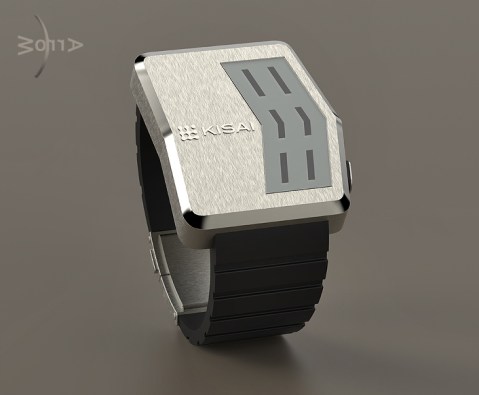
Design submitted by José from Spain.
José says: Seeking a solution to display an seemingly incomprehensible information despite it being front of our eyes, I found, without trying to create a new cryptographic code, a simple visual effect that applied to the time display, makes this result different and “unique”. Let me introduce ARROW concept watch.

Design submitted by Laszlo from Hungary.
Laszlo says: Cryptic signs at first glance but they are simply numbers in two rows.
In the upper row you can read the hours and the minutes and in the lower row is the seconds.
That’s Chakana LCD watch.
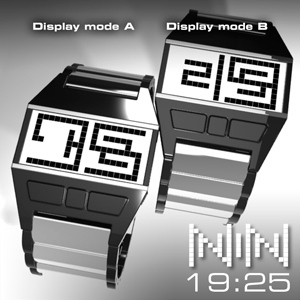
Design submitted by Laszlo from Hungary.
Laszlo says: NIN is an easy to read LCD watch concept with time and date functions.
Two digits on the left side indicate the hours or months (the inner little number is the first and the outer bigger number is the second number of the hours or month). The two digits on the right side are the minutes or days (the inner little number is the first and the outer bigger number is the second number of the minutes or days).

Design submitted by Peter from the UK.
Peter says: I was trying to think of a really intuitive analogue style time telling method that could be easily made using an LCD display. I have played around on previous designs with rings that describe the hours (orbital decay) and others that use dots to highlight the analogue positions on a watch face (Tri-Ripple) so I decided to combine both of these elements.

Design submitted by Peter from the UK.
Peter says: I recently created a design with a time telling display using two or three faces of a cube in an analogue style called “Anacube“. This made we wonder if I could use more if not all the faces of a cube to tell the time in an analogue format. This combined with another idea for a watch using a 3D snake to illustrate the time resulted in “Hexahedron”
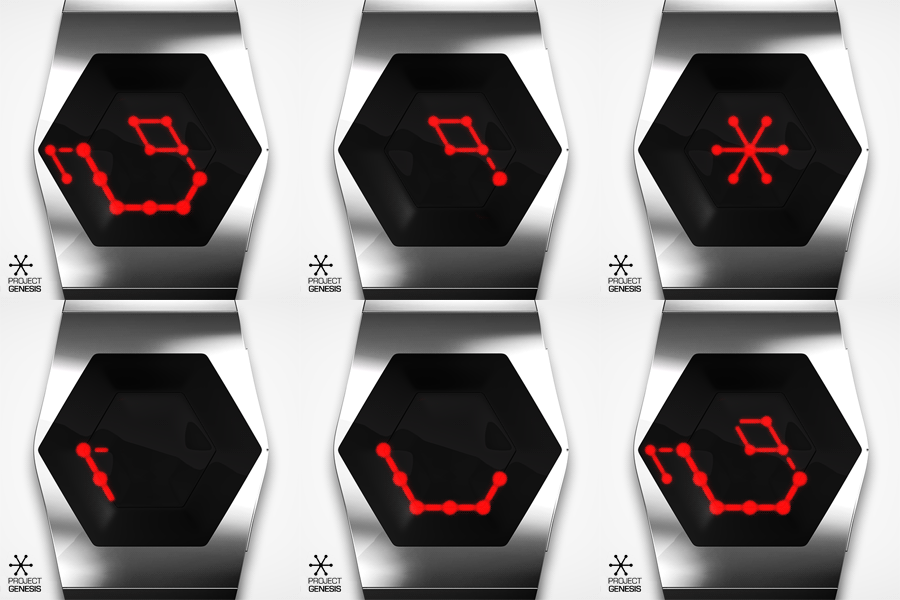
Design submitted by Sam from Germany.
Sam says: The basic idea for Genesis is a molecular looking displaying method made of sticks and dots.
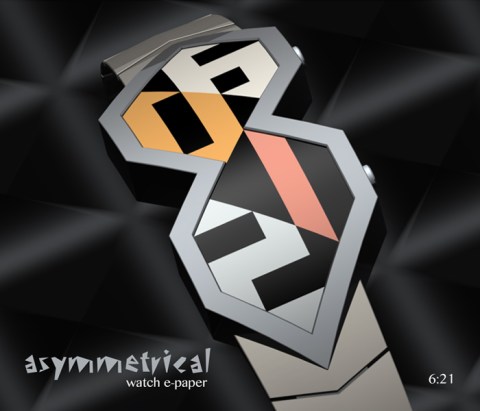
Design submitted by Patrick from France.
Patrick says: Asymmetric Watch “e-paper” it is a variant of “Hiding-Watch”. Its originality lies in its asymmetrical shape. The dial reading is curved thanks to technology “e-paper”.

Design submitted by Heather from the USA.
Heather says: This idea was developed in reverse of my usual concepts. I first designed the straps and case, and then designed the digits to fit vertically on the display area.
 Tokyoflash Japan