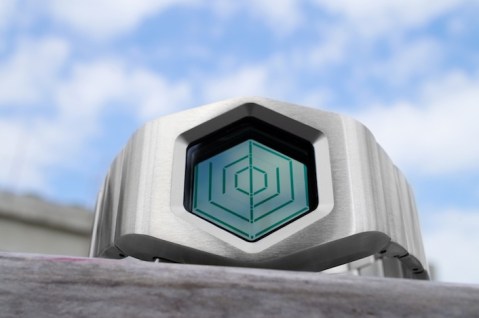
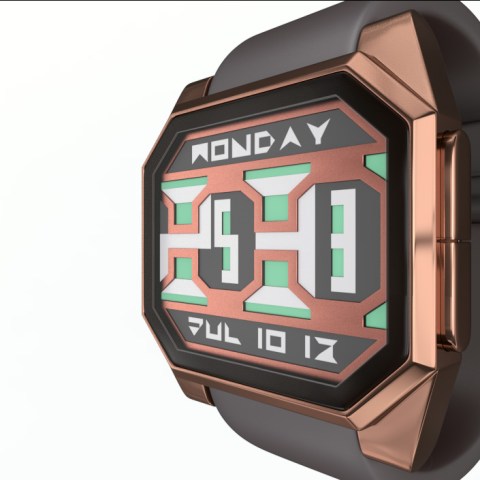
April 2nd, 2012
(English)
Design submitted by Lloyd from Australia.
Lloyd says: “In this concept watch design called “Bubbles” the digits are hidden in groups of bubbles. Each of the watch’s 4 oval windows contains 8 identical overlapping transparent bubbles. Read the rest of this entry »
February 21st, 2012
(English)
Kisai Stencil is the fifth fan-submitted concept to become reality from the Tokyoflash Design Studio Blog. The conceptual idea for Kisai Stencil was submitted in September 2011 by a reader of the blog and fan of Tokyoflash, Heather Sable from the USA. Read the rest of this entry »
January 25th, 2012
(English)
Kisai Optical Illusion is the latest concept to become reality from the Tokyoflash Design Studio Blog. The concept was originally featured on the blog in September 2010. Kisai Optical Illusion is now available to buy in a choice of four color variations. Read the rest of this entry »
December 7th, 2011
(English) Design submitted by Heather from the USA.
Heather says: I was sketching digits that appeared to be folded over two faces of a cube, when it occurred to me that they would look even more interesting if one face showed a positive display of the digit, while the other showed a negative one. The display is “TWOFOLD”. Read the rest of this entry »
November 25th, 2011
(English) Design submitted by Peter from the UK.
Peter says: This is “Glow”, I was trying to come up with an LED watch that didn’t tell the time directly with the LEDs. So I decided it would be nice if you read the time using the light given off by the LEDs. Read the rest of this entry »
October 25th, 2011
(English) Design submitted by Denise from the Philippines.
Denise says: “I wanted to create a minimalist watch that would look sophisticated and cool at the same time”. Read the rest of this entry »
October 19th, 2011
(English) Design submitted by Heather from the USA.
Heather says: “I’ve been playing with the idea of splitting digits lengthwise to make them cryptic but readable. It appears to be a code, but they are just digits in disguise!”. Read the rest of this entry »
October 18th, 2011
(English) Design submitted by Peter from UK.
Peter says: “I am a bit of a petrol head and wanted to do a car related watch. I figured that a tyre rather lent itself to a watch strap so I went from there. The tread in the tyre resembled a basic digital display and here we are”. Read the rest of this entry »
October 11th, 2011
(English) Design submitted by Peter from UK.
This watch design is a combination of Sci-Fi and retro design. The classic flying saucer shape seemed to lend itself to a watch. Read the rest of this entry »
October 7th, 2011
(English)
A new concept from the Tokyoflash Design Studio.
This artistic concept watch design has an LCD display showing a combination of positive and negative shapes that combine to show time time digitally. At first glance, the display might appear to be an arrangement of cryptic shapes but when your eyes adjust you can see the time at a glance. Read the rest of this entry »
October 6th, 2011
(English) Design submitted by Peter from the UK.
This simple LED watch design may look cryptic at first until you look at it from a different perspective. But rather than move the watch to find the correct perspective, you move an element of the watch. Read the rest of this entry »
October 5th, 2011
(English) Design submitted by Laszlo from Hungary.
This watch design uses only the numbers 1, 2, 4, and 5 to display the time and date in three columns. Read the rest of this entry »
September 30th, 2011
(English)
Collaboration design submitted by Peter from England and Sam from Germany.
“The idea for this watch design concept comes from dot to dot drawing. These “coded” images have their own artistic appeal and make an interesting display for a watch. Read the rest of this entry »
September 29th, 2011
(English) Design submitted by Peter from UK.
The inspiration for this watch design came from early photofits which were made up from three to four sections of faces. These sections were interchangeable so that a likeness could be made by combining the sections.
Read the rest of this entry »